
Dopamine, Speech Production, and Stuttering


Fluent speech requires the precise coordination of rapidly unfolding motor actions. During conversation, speakers produce several syllables per second, each involving precisely timed movements of the tongue, lips, jaw, and larynx. These articulatory gestures must occur in the correct sequence and with extremely accurate timing for speech to sound smooth and continuous. Because speech relies on the rapid execution of highly practiced motor sequences, the neural systems responsible for initiating and reinforcing these movements play a central role in maintaining speech fluency.
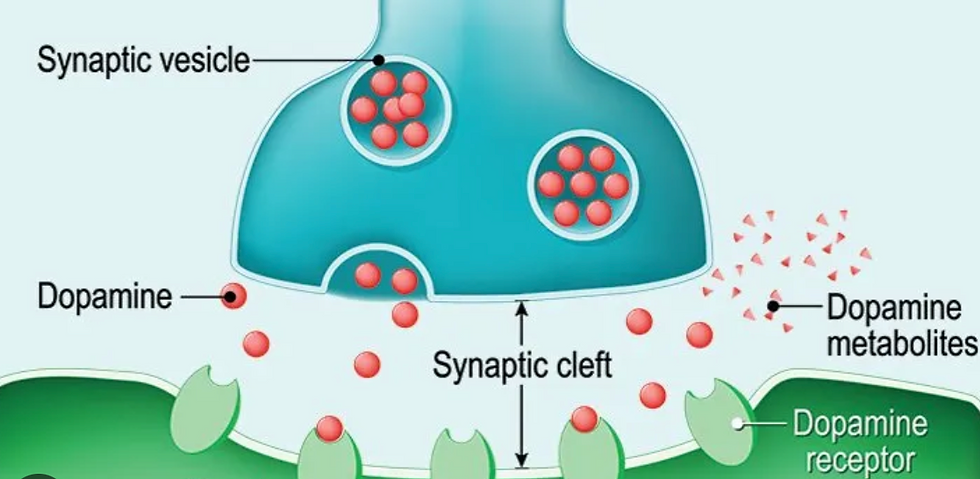
One neurochemical system that has received considerable attention in research on speech production and stuttering is the dopamine system. Dopamine is a neurotransmitter; a chemical messenger that neurons use to communicate with one another. Within the brain, dopamine is involved in several important functions, including movement control, reinforcement learning, euphoria, motivation, and the gradual automatization of skilled motor behaviors. These functions make dopamine particularly relevant for understanding speech production, which depends on the rapid execution of complex, learned motor sequences.
Dopaminergic neurons originate primarily in midbrain structures such as the substantia nigra and the ventral tegmental area (VTA). From these regions, dopamine-producing neurons project to multiple areas of the brain, including the basal ganglia, a group of subcortical nuclei that play a central role in regulating movement. Within the basal ganglia, dopamine helps modulate neural circuits that determine when movements should begin and how sequences of movements are organized.
The basal ganglia regulate movement through two major pathways known as the direct pathway and the indirect pathway. The direct pathway facilitates the initiation of movement, while the indirect pathway suppresses competing motor programs. Dopamine influences both of these pathways simultaneously. It enhances activity within the direct pathway and reduces activity within the indirect pathway. Through this dual mechanism, dopamine promotes the initiation of appropriate movements while preventing interference from competing motor signals. This regulatory system is of utmost significance for behaviors that involve rapid sequences of movements, such as speech. Producing a single word requires coordinated activation of multiple muscles controlling the tongue, lips, vocal folds, and respiratory system. Rather than controlling each articulatory gesture individually, the brain organizes these gestures into coordinated motor sequences that can unfold automatically during fluent speech.

Dopamine plays an important role in the development and stabilization of these motor sequences through processes of motor learning and reinforcement. During skill acquisition, dopaminergic signaling helps strengthen successful motor patterns while weakening unsuccessful ones. Over time, repeated practice allows complex actions to become increasingly automated. Because speech is practiced continuously from early childhood, dopaminergic reinforcement mechanisms are thought to contribute to the development of stable articulatory patterns that support fluent speech (Alm, 2021).
Because of this, researchers have proposed that differences in dopaminergic signaling may influence speech fluency. One of the earliest lines of evidence supporting this idea came from neuroimaging studies examining dopamine activity in the brains of individuals who stutter. Using positron emission tomography (PET scan), Wu et al. (1997) reported increased dopamine activity in the striatum of individuals who stutter compared with fluent speakers. The striatum is a central component of basal ganglia circuits involved in movement initiation and sequencing. Elevated dopamine activity in this region suggested that dopaminergic signaling within basal ganglia networks may be altered in people who stutter.
Subsequent imaging research has provided further insight into dopaminergic function in stuttering. In a later PET study examining dopamine receptor binding, Wu et al. (2001) reported increased availability of dopamine D2 receptors within striatal regions in individuals who stutter. Dopamine receptors are proteins located on neurons that respond to dopamine signaling. Two major classes of receptors, the D1 receptors and the D2 receptors, play different roles in basal ganglia circuits. D1 receptors are associated with the direct pathway that facilitates movement initiation, whereas D2 receptors are associated with the indirect pathway that suppresses competing movements. Alterations in D2 receptor activity within the basal ganglia influences the balance between movement facilitation and inhibition. Some researchers have proposed that increased D2 receptor activity may contribute to instability in the neural systems responsible for initiating motor programs. In the context of speech production, such instability could potentially interfere with the smooth release of successive articulatory movements, contributing to the repetitions, prolongations, or blocks observed in stuttering.
Additional support for dopaminergic involvement in stuttering comes from pharmacological research. Certain medications that reduce dopaminergic signaling, like dopamine receptor antagonists, have been observed to reduce stuttering severity in some individuals. Conversely, medications that increase dopaminergic activity may sometimes worsen speech disruptions (Maguire et al., 2010). Although these effects vary across individuals and do not fully explain the disorder, they are consistent with the possibility that dopaminergic mechanisms influence the neural systems responsible for regulating speech motor sequences.
Research has also suggested that dopamine may contribute to the well-known variability of stuttering across speaking situations. Dopaminergic systems are closely linked to motivation, reward processing, and emotional regulation. Because dopamine influences reinforcement learning and movement sequencing, changes in dopaminergic signaling may affect how reliably speech motor programs are initiated in different contexts. This may help explain why individuals who stutter often experience changes in fluency depending on factors such as speaking environment, emotional state, or communicative demands (Alm, 2021).
Ongoing research continues to investigate how dopamine interacts with neural circuits involved in speech motor control and how differences in dopaminergic signaling may contribute to disruptions in speech fluency. By studying the neurochemical systems that shape motor learning and movement sequencing, researchers hope to gain deeper insight into the neural processes that support fluent communication.
References
Alm, P. A. (2021). The dopamine system and automatization of movement sequences: A review with relevance for speech and stuttering. Frontiers in Human Neuroscience, 15, 661880. https://doi.org/10.3389/fnhum.2021.661880
Maguire, G. A., Yeh, C., & Ito, B. S. (2010). Overview of the diagnosis and treatment of stuttering. Journal of Experimental & Clinical Medicine, 2(2), 92–97.
Wu, J. C., Maguire, G., Riley, G., Lee, A., Keator, D., Tang, C., Fallon, J., & Najafi, A. (1997). Increased dopamine activity associated with stuttering. NeuroReport, 8(3), 767–770.
Wu, J. C., Maguire, G., Riley, G., Fallon, J., LaCasse, L., Chin, S., & Najafi, A. (2001). Increased dopamine receptor availability in developmental stuttering. Neurology, 56(12), 1741–1743.


